
Are You Mad At Me?

A couple weeks ago, after leaving one of my kids sports events, I couldn’t shake a feeling. My husband asked, “Are you okay?” I embarrassingly admitted something that happens to me a lot.
“I’m fine I guess….I just feel like I did something wrong. Like everyone is mad at me.” He looked at me like I was crazy and went on to tell me that there couldn’t possibly be a reason for everyone to be mad at me when all I’d been doing was cheering on my kid.
The next day, the library called to tell me the book I reserved was ready for pick up. This is the best part of my week. Walking up to the library not remembering exactly which books I reserved and seeing it with excitement. Right before my eyes, with a Perkins, S slip hanging out of the pages was the book I’d been waiting for.
It’s called Are You Mad At Me? by Meg Josephson.
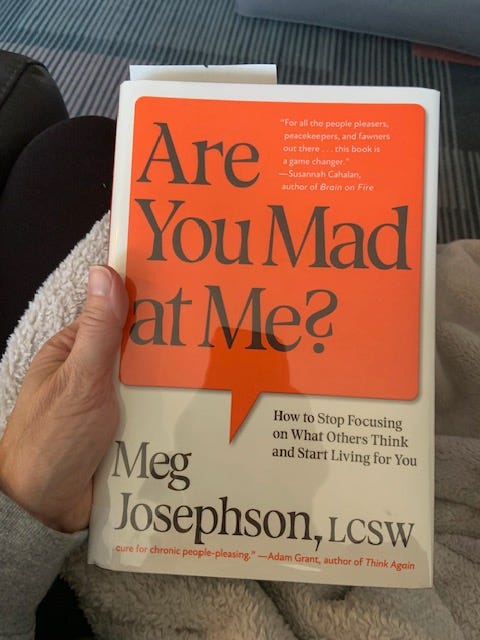
I remember putting this book on my list after Holly Whitakar made a post about it. I love many of her book recommendations and the title summed up how I’ve felt most of my life in less than a second.
Could it be true? Other people-who are adults-wonder this too?
I finished the book last night and thanks to Meg Josephson I now have more clarity.
One of the biggest things that I’ve had to work through during my sobriety journey is the shame I’ve felt for all the ways in which I used to abandon myself. When living between a state of drunk and hungover, I made decisions that were rarely in my best interest.
I abandoned my sleep by staying awake when I was tired.
I abandoned my body by eating horrible foods and drinking too much alcohol and caffeine.
I abandoned my needs by saying yes when I didn’t have capacity or energy.
I abandoned my desires by only focusing on pleasing the person I was with at the moment.
I abandoned my hopes by numbing myself.
I abandoned my finances by refusing to open my mail or pay my bills.
I abandoned my car by not taking care of it.
I abandoned my values by never believing that I was worthy enough to have them in the first place.
The list goes on and on. The thing is, I didn’t just abandon myself because I was in a drunken haze holed up in some bar (at least not all of the time). I did it because I was trying to please the person I was with. I was abandoning myself in order to make myself more likable. I thought people pleasing was what I was supposed to do.
I’ve worked with this part of myself for a long time. I’ve healed a lot of my anxiety and perfectionism through many different tricks and techniques-sobriety, meditation, movement, journaling, therapy, medication, rebalancing my hormones, going for walks in nature, getting enough sleep, eating the right foods, and more.
Are You Mad At Me helped me realize that the root of some of my clinging for life people pleasing and perfectionism isn’t anxiety but instead-fawning. Meg says, A lot of us are familiar with fight, flight or freeze as threat responses, but we actually have a fourth, which is the reflex to appease and pander to the threat.
Fawning is something that I learned in childhood. It was the appropriate response I needed to take on in order to feel safe when faced with threats. And, it’s something that I’ve continued to do for my entire life.
Basically, the message I received as a child was that in order to be liked you had to conform to the person you were with. I got really good at studying my subjects and ensuring that my body language matched theirs, my moods matched their moods, my words matched their words, and more. In middle school, this meant dressing in clothes I didn’t really even like in order to be in style (or at least, not get made fun of). In adulthood, this means laughing at jokes I don’t think are funny or being agreeable even when I REALLY DISAGREE.
I’ve held this deep belief that as long as I’m likable, I’m a good person. Unlikeable=Bad. And bad is just something I didn’t feel that I could cope with.
While, I’ve worked to cope with the anxiety I feel when I let people down-I haven’t ever healed the root of my fawning. I still haven’t quite helped my inner child who just wants to be liked and accepted.
This explains why after all of this work-I still sometimes leave social settings feeling the need to apologize for something-like texting Hey-Sorry for being so-you know-awkward and weird. Or, feeling the need to over explain no matter what (I’m sorry, it’s just that I have anxiety ha-ha-ha).
Meg’s advice was to create awareness. I have practiced a version of this for years, but in my busy world it’s so easy to forget. So, when I feel a thought come up (did I do something wrong?) I can use mindfulness to explore the thought before jumping into a spiral about how I need to go back and please all the people. This looks like using the acronym NICER
N-Notice the feeling
I-Invite the feeling to be here
C-Get Curious about where the feeling is coming from
E-Embrace the feeling
R-Recognize what’s around me in this moment
I’m not a pro at this just yet (the perfectionists in me really wants to be). But, I did immediately restart my paused meditation practice and guide my journaling practice back toward my inner child. The most important thing, was hearing that I’m not alone and this isn’t just another “Samantha” problem. I can unlearn this habit and heal parts of me that I have yet to heal.
Maybe you can too?
I started a podcast! I’m really excited to interview authors to talk about the writing process, how it healed them and what it was like writing vulnerable things. Please check it out!
Do you want to dive deeper into a writing practice and heal even more? Work with me.
The way you connect fawning to self-abandonment is powerful. It reframes people-pleasing from a personality trait into a survival strategy that outlived its original purpose. That’s intelligence that learned how to stay safe. And the list of ways you abandoned yourself is heartbreaking and compassionate at the same time. It shows how slowly and subtly disconnection can build when love is conditional and approval feels like oxygen.
Loved this piece this week! I've been in a similar struggle with my fawning tendencies that I'm working through. I wrote this down last week and I've been really leaning in to clarifying this for myself -
The desire to not be a burden has driven what I have accepted.
Whether it comes to my personal or professional life, I can see where I have let this desire - to not be a burden, to be agreeable - squash who I am and gotten in the way of who I want to become.
Your struggles are relatable and shared by many of us, letting us know we're not alone. No one can be mad at you for that!